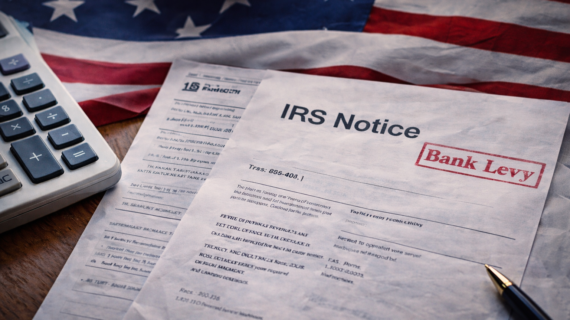
An IRS bank levy is one of the most serious collection actions the Internal Revenue Service can take. If you owe back taxes and ignore IRS notices, the agency has the legal authority to seize money directly from your bank account. Understanding how this enforcement process works can help you protect your finances before funds are frozen.
This guide explains when the IRS can take money from your bank account, how the levy process works, your legal rights, and the steps you can take to stop or prevent collection action.
Before continuing, review how penalties accumulate in our guide on IRS Penalty for Late Filing.
What Is an IRS Bank Levy?
An IRS bank levy is a legal seizure of funds from your financial account to satisfy unpaid tax debt. Once issued, your bank must freeze available funds up to the amount stated in the levy notice.
Unlike a tax lien, which is a public claim against property, a levy actually removes money from your account.
When Can the IRS Issue a Bank Account Levy?
The IRS cannot seize funds without following required legal steps. Federal law requires the agency to complete a structured collection process first.
Required Steps Before a Federal Tax Levy
- Assessment of tax liability
- Notice and demand for payment
- Final Notice of Intent to Levy
- 30-day waiting period
If you fail to respond within 30 days after the Final Notice, enforced collection may begin.
How the IRS Levy Process Works
Once the levy notice is sent to your bank, the institution must freeze available funds for 21 days. During this holding period, you may still resolve the issue and potentially secure a release.
After 21 days, the frozen funds are transferred to the U.S. Treasury unless the action is reversed.
How Much Money Can the IRS Take?
The agency may seize funds up to the total tax debt owed. This includes:
- Unpaid taxes
- Failure-to-file penalties
- Failure-to-pay penalties
- Accrued interest
If new deposits are made after the levy date, they are generally not affected unless another levy is issued.
Can the IRS Take Money From a Joint Bank Account?
Yes, a bank account levy can affect joint accounts if one account holder owes federal tax debt. However, the non-liable account holder may claim their portion by proving ownership of funds.
How to Stop an IRS Bank Levy
If you act quickly, you may be able to stop an IRS bank levy before funds are transferred.
1. Pay the Balance in Full
Paying the tax debt immediately can result in release of the levy action.
2. Set Up an Installment Agreement
Entering into a formal payment plan may suspend further enforced collection.
3. Request a Collection Due Process Hearing
If you are within the 30-day window, you may request a hearing to challenge the levy decision.
4. Demonstrate Financial Hardship
You may qualify for Currently Not Collectible (CNC) status if the seizure creates economic hardship.
For official information about levy procedures, review guidance at IRS.gov.
Difference Between a Bank Levy and Wage Garnishment
A bank levy is generally a one-time seizure of available funds, while wage garnishment continuously deducts a portion of each paycheck until the tax debt is resolved.
Your Rights During an IRS Bank Levy
Taxpayers are protected under the Taxpayer Bill of Rights, including:
- The right to be informed
- The right to appeal IRS decisions
- The right to retain representation
- The right to fair treatment
How to Prevent a Bank Account Levy
- Respond to IRS notices immediately
- File all required returns
- Set up payment arrangements early
- Maintain open communication with the IRS
Ignoring notices significantly increases the risk of enforced collection action.
Common Mistakes That Trigger Enforcement
- Ignoring Final Notice of Intent to Levy
- Failing to open IRS mail
- Missing installment deadlines
- Accumulating additional tax debt
Frequently Asked Questions
Can the IRS freeze my bank account without notice?
No. The IRS must issue a Final Notice of Intent to Levy and wait 30 days before seizing funds.
How long does a bank levy last?
Banks must hold frozen funds for 21 days before transferring them.
Can a levy be reversed?
Yes. If the debt is resolved or hardship is proven, the IRS may release the levy.
Final Thoughts
An IRS bank levy is serious but preventable. Acting early, responding to notices, and establishing payment arrangements are the most effective ways to protect your bank account from enforced collection.
Taking immediate action reduces financial damage and preserves your available options.